
Short answer
A direct OTF-specific answer on whether black coated blades are better than satin blades, with real buying criteria, failure modes, and a practical inspection c
Key Takeaways
- Knife rules can vary by state, city, blade style, opening mechanism, carry method, and intended use.
- Do not treat a product nickname as a legal category; check the actual features and local rule.
- Retailers should keep legal or safety language factual and avoid promising that one item is allowed everywhere.
Terms Used Here
- OTF
- Out-the-front; a knife design where the blade moves forward from the front of the handle.
- Automatic knife
- A knife that opens by a spring-driven mechanism after the user activates a button, switch, or slider.
In this article
- 01 Short answer: satin wins on honesty and simplicity, black coating wins on glare control and appearance
- 02 Why OTF knives make this comparison different
- 03 When black coated is the better answer
- 04 When satin is the better answer
- 05 What wholesale buyers should inspect before purchase
- 06 Bottom-line comparison for resellers and serious users
- 07 FAQ
- 08 Does a black coated OTF blade rust less?
- 09 Does black coating make an OTF deploy slower?
- 10 Which finish gets fewer customer complaints?
- 11 Which finish is better for private-label OTF programs?
Usually no: a black coated blade is not automatically better than a satin blade on an OTF knife, because the better choice depends on carry use, finish quality, and how the OTF mechanism will be maintained.
The caveat is that black coating often becomes the smarter option when low glare, cosmetic concealment of wear, or tactical retail appeal matters more than easy scratch visibility and simpler refinishing.
For most OTF users, satin is the safer default because it shows the real steel condition, tends to hide coating failure by not having any coating to fail, and avoids one common complaint in side-opening and out-the-front automatics alike: the blade looks worn long before the edge is actually worn. That changes when the knife is carried in uniform, used around bright light, or sold into a market that strongly prefers a subdued tactical look. On an OTF, that choice is not only cosmetic. The blade runs through the front opening, rides on internal tracks, and is repeatedly exposed and retracted by spring tension, so finish durability and friction behavior matter more than they do on a simple manual folder.
Short answer: satin wins on honesty and simplicity, black coating wins on glare control and appearance
If the question is which blade finish is better overall, satin usually wins because it is simpler, easier to inspect, and less dependent on coating quality. If the question is which finish is better for a specific OTF use case, black coating can be the better choice.
Satin blade: best for everyday utility, buyers who want visible steel condition, and resellers who want fewer complaints about finish rub.
Satin blade: not ideal for users who want low reflectivity or a tactical visual style.
Black coated blade: best for low-glare carry, duty-style presentation, and product lines where customers expect a blacked-out look.
Black coated blade: not ideal for low-cost builds with thin coatings or buyers who dislike visible edge-line contrast and track wear.
The main tradeoff that changes the recommendation is simple: appearance retention versus finish honesty. A good black coating can make an OTF look cleaner in use and less reflective in carry, but a poor coating often shows ugly rub marks at the blade shoulders, on the flats, and near the front opening after repeated deployment cycles. Satin cannot chip or peel, but it will show scratches and fingerprints more openly.
Why OTF knives make this comparison different
On an OTF knife, the blade does not just sit in open air. It launches through the chassis opening, retracts along internal rails, and usually contacts the mechanism at consistent points. That creates OTF-specific wear patterns.
- Track contact wear: coated blades often develop polished lines where the finish rubs against guide surfaces.
- Mouth wear at the front opening: repeated firing can mark the blade near the exit point, especially if tolerances are rough.
- Lint and debris visibility: satin often makes dirt easier to spot and clean; black finishes can hide buildup until deployment feels slower or grittier.
- Edge contrast: once sharpened, many black blades show a bright exposed bevel, which some buyers dislike and others expect.
This is why material alone does not decide the answer. It depends on build quality. A premium DLC or well-applied PVD on a tight OTF can hold up very well. A budget painted or thin-coated blade on a loose chassis often starts showing silver streaks quickly, even if the underlying steel is decent.
Buyers comparing options in an OTF knife collection should compare finish type within the same price band and factory level. It is not useful to compare a premium coated OTF against a budget satin OTF and call the finish the deciding factor.
When black coated is the better answer
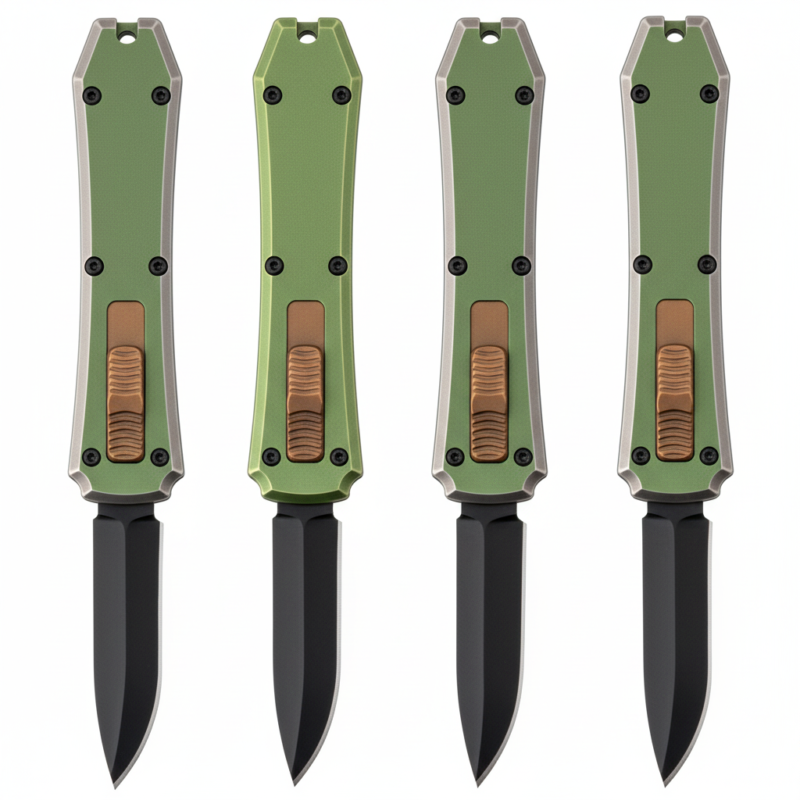
Black coated blades are better when the user values reduced reflection, a more discreet profile, or a stronger tactical presentation at retail. That is especially true for OTF knives sold alongside self-defense products, where customers often want a non-reflective look and a consistent blacked-out package.
Concrete examples where black coating is often the smarter pick:
- Night-shift or uniform carry: a satin blade can flash under vehicle lights or indoor LEDs when deployed. A black blade usually reduces that glare.
- Retail display appeal: black-on-black OTF models often sell faster in tactical-heavy assortments, even when the satin version is mechanically identical.
- Cosmetic concealment of staining: on steels that can pick up marks from sweat or humid storage, coating can help the knife look cleaner between maintenance cycles.
- Private-label styling: if a buyer is building a modern, duty-style line, satin may look too traditional next to black hardware and black handles.
Failure modes still matter. A black blade can look worse than satin if the coating is soft, uneven, or poorly bonded. One common complaint on cheaper OTFs is a black finish that rubs off in two bright lines along the blade flats after a short break-in period. Another is chipping near the blade opening where repeated impact and friction concentrate. Those are not reasons to reject all coated blades; they are reasons to inspect the coating system and sample the mechanism before committing to volume.
When satin is the better answer
Satin is better when the user wants a straightforward working finish, easier inspection, and fewer surprises over time. On OTF knives used for box cutting, warehouse tasks, light field utility, or general resale to practical buyers, satin often creates fewer post-sale complaints.
Why satin often wins in real use:
- What you see is what you get: scratches are steel scratches, not coating wear that can be mistaken for abuse or poor quality.
- Easier quality control: wholesalers and dealers can inspect grind lines, surface flaws, and corrosion spots more directly.
- No coating edge halo: after sharpening, the blade still looks consistent rather than showing a bright bevel against a dark blade face.
- Lower finish-risk on budget models: when the factory cannot deliver a durable coating, satin is usually the safer specification.
There are OTF-specific reasons too. If a knife will be fired often for demonstration, handling, or counter sales, satin avoids the “why is the black rubbing off?” question. If the mechanism is slightly gritty during break-in, satin shows witness marks without making the knife look cosmetically damaged.
A practical example: a distributor selling entry-level OTFs into farm-supply or hardware channels will often do better with satin because the customer expects visible wear and values easy cleaning over stealth aesthetics. In that lane, the cheaper-looking option can actually be the smarter pick.
What wholesale buyers should inspect before purchase
Before placing an order, inspect both the finish and the action on actual samples, not just photos.
- Cycle test the blade: deploy and retract it repeatedly to check for early rub lines near the front opening and along the track contact points.
- Ask what the black finish actually is: DLC, PVD, oxide, and painted coatings do not wear the same way.
- Inspect the blade shoulders and flats: these spots often reveal poor coating adhesion first on OTFs.
- Check edge appearance after one sharpening: make sure the bright bevel against a black blade is acceptable for your market.
- Compare identical models only: same steel, same factory, same mechanism, different finish. Otherwise the test is not fair.
A common mistake is buying black-coated OTFs from a low-cost maker because the sample looked dramatic in photos, then discovering that store returns come from finish wear rather than mechanical failure. Another mistake is assuming satin is always “cheaper.” On some better OTF builds, a clean satin grind is harder to execute consistently than a dark coated finish that hides minor cosmetic flaws.
Bottom-line comparison for resellers and serious users
- Choose satin if your priority is honest wear, easy inspection, lower finish risk, and broad utility appeal.
- Choose black coated if your priority is low glare, tactical styling, and a market that accepts normal finish rub as part of OTF use.
- Upgrade the coating or skip it on budget OTFs; weak coating is often worse than no coating.
- Do not over-credit the finish if the mechanism, tolerances, or steel choice are the real quality limit.
The clearest quotable answer is this: On an OTF knife, satin is usually the better all-around finish, while black coating is the better mission-specific finish. If you need one default SKU for mixed retail, satin is safer. If you know your customer wants low visibility and tactical styling, a well-coated black blade often sells better and carries better.
FAQ
Does a black coated OTF blade rust less?
Often yes, but only to a point, and it depends on build quality. The coating can add surface protection, but the edge, exposed steel areas, and any worn contact lines still need normal care.
Does black coating make an OTF deploy slower?
Usually no on a well-built knife. On poorly finished OTFs, a rough or thick coating can add drag at contact points and may show wear quickly during break-in.
Which finish gets fewer customer complaints?
Satin usually gets fewer complaints on entry and mid-level OTFs because buyers understand scratches better than coating rub. Black coating often performs well when the customer already expects a tactical finish and premium presentation.
Which finish is better for private-label OTF programs?
It depends on your target market. Satin is safer for broad utility channels. Black coated is often stronger for tactical branding, provided the coating system is durable enough for repeated OTF cycling.